Eight wires. Zero forgiveness.
T568A against T568B, straight against crossover. Set the standard, build both ends, prove it on the tester.
End 1: T568B
Same order both ends. PC into switch into PC.
End 2: T568B
When straight, when crossed
Straight (same both ends): everything through a switch, which is 99 percent of life. Crossover (pairs 2 and 3 swapped): like to like before Auto-MDIX, PC to PC, switch to switch, ancient uplink ports. Modern ports auto-sense, so crossover is now mostly trivia plus exams.
The split-pair trap
A continuity tester can pass a split pair (pin 3 wired with the wrong white, for example). It will “work” at 10 Mbps and collapse at gigabit. Only a qualification or certification test catches it. Keep pairs together.
Drag the plug. Click a pin.
A procedural model: eight gold contacts, eight colour-coded conductors, clip and all.
The canvas above is the instrument. The pin buttons below it read the same facts without WebGL.
Solid or stranded, plenum or riser
Solid-core goes in the walls
One thick conductor per wire. Holds a punch-down IDC blade gas-tight for decades, lower attenuation. Never flex it daily: it work-hardens and snaps. 90 m horizontal, punch-down keystones, 23 AWG.
Stranded goes in patch leads
Dozens of hair-thin strands. Survives bending, coiling, chair wheels. Slightly lossier, which is why patch plus equipment cords are capped at 10 m total. Flex-rated, crimp plugs, 24 to 26 AWG.
CMP plenum goes in air spaces
Drop ceilings and ducts that carry air. Plenum jackets char and self-extinguish with low smoke. Code-mandated in air-handling spaces in most jurisdictions.
CMR riser goes floor to floor
Vertical shafts between floors. Flame-retardant so fire does not ride the shaft. Cheaper than plenum. Outdoors, take UV plus gel-filled or conduit: indoor jackets die in a summer.
Terminate a jack in 9 steps.
What you need: cable stripper, 110 punch-down tool, keystone jack, side cutters, tester.
- 1
Strip 40 mm, do not nick
Score the jacket only, flex and slide off. Nicked copper means a future break. Keep twists intact.
- 2
Fold back rip-cord and spline
Cut the plastic cross flush. Fan pairs out in order, never crossing over each other.
- 3
Order per T568B
WO-O, WG-G, WB-B, WBr-Br across the jack colour map. Double-check before seating.
- 4
Keep twist to the blade
Dress each wire into its IDC slot with twist preserved to under 13 mm from contact.
- 5
Punch, do not push
110 tool blade-out, one firm strike per wire. It seats and trims the tail.
- 6
Inspect the blades
Copper should be fully sunk, tails cut, no copper showing beyond the cap.
- 7
Cap it and seat it
Snap the dust cap or wire holder, click the jack into plate or panel.
- 8
Same standard both ends
A on one end plus B on the other is an accidental crossover. Label the run.
- 9
Test, then trust
Wiremap first, length plus PoE load next. Re-terminate any pair that is not perfect.
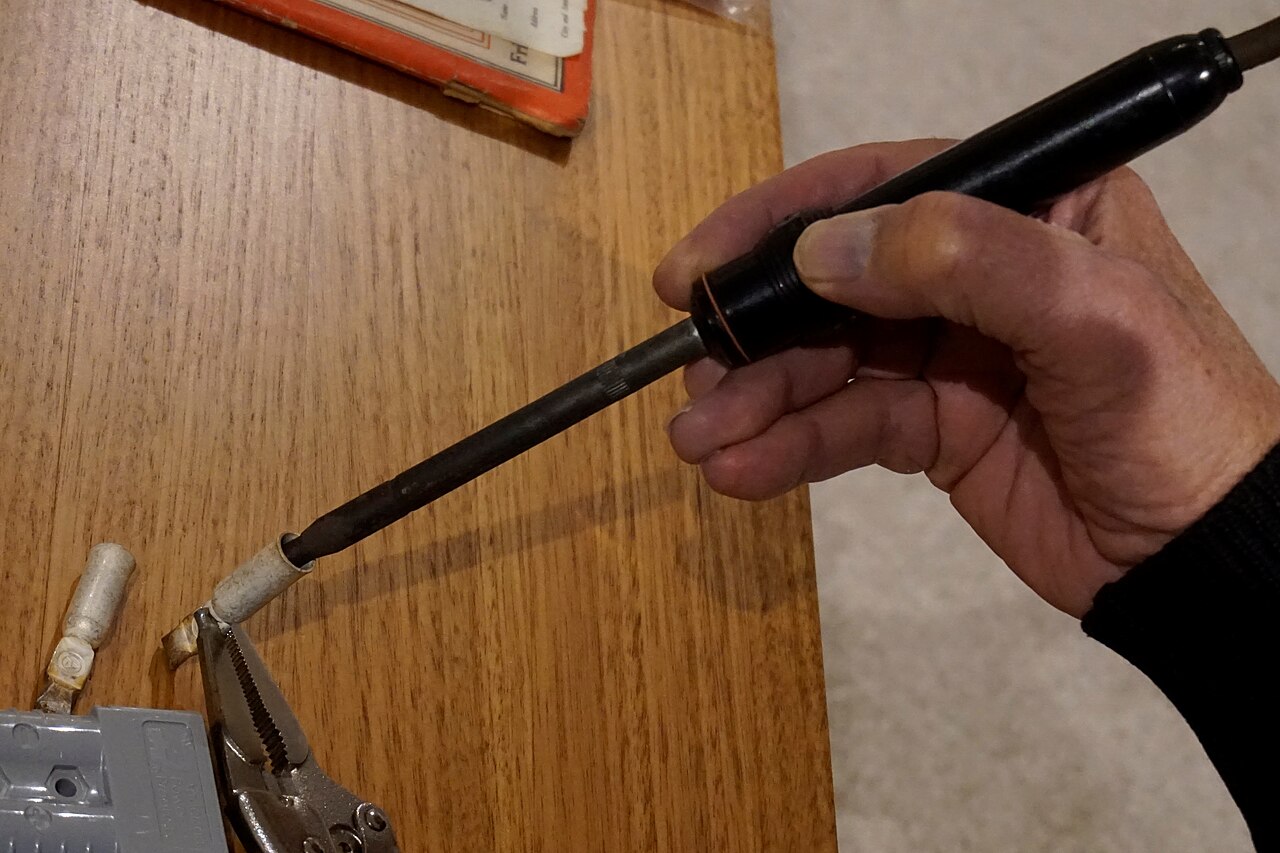
The bench: strip, seat, punch, prove. Photograph: Doug Butler, CC BY-SA 3.0, via Wikimedia Commons.
The bench checklist
Break it here, not in the wall.
A wiremap simulator. Inject a fault, then read the tester like it is 11 pm and the client demo is tomorrow.
Fault injector
Clean sweep. Ship it.
What each tester tells you
- $15 continuity tester: opens, shorts, miswires, split pairs (basic). Finds 80 percent of DIY faults.
- $300 qualifier: length per pair, PoE load, speed capability. The sweet spot for installers.
- $1,500 certifier: NEXT, return loss, alien crosstalk against the CAT spec. The warranty paper.
Top five field faults
- Untwist past 13 mm at the jack
- A on one end, B on the other
- Nicked conductor from stripping
- Stranded wire in a solid-only IDC
- Kink tighter than four times the diameter